A cardinal spline: a Catmull-Rom spline with a :tension option that sets how tightly the curve
bends at each knot.
You only give the knots, and the curve passes through every one of them. At each knot the curve
heads in the direction from the knot before it to the knot after it. :tension sets how fast:
:tension | The curve... |
|---|---|
0.0 (the default) | is exactly a Curves.Spline.Type.CatmullRom spline |
between 0.0 and 1.0 | bends more tightly at each knot, with straighter lines between them |
1.0 | stops at every knot: straight lines that slow down at each knot |
below 0.0 | swings wider around each knot |
A spline with n knots has n - 1 segments, like Catmull-Rom.
curve = Curves.define_cardinal([{0, 0}, {2, 3}, {4, 1}, {6, 4}, {8, 2}], tension: 0.5)

# Find any point along the curve (u goes from 0.0 to Curves.max_u(curve))...
Curves.solve!(curve, 1.5)

# ...or draw the whole curve as an SVG image
Curves.Svg.save!(curve, "cardinal.svg")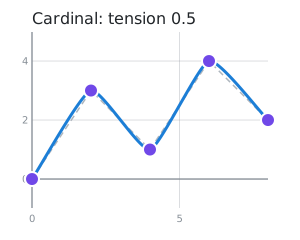
How it is built
The tangent at each knot is (1 - tension) * (next_knot - previous_knot) / 2. The first and last
knots have no knot on one side, so the curve leaves the start heading straight for the second
knot, and arrives at the end from the second-to-last one (the same as Catmull-Rom). Each segment
is then the Hermite segment between two knots, stored as a cubic Bezier curve.